Understanding the Opportunity Class Test
Opportunity Classes provide a stimulating learning environment for academically gifted students, fostering their potential through specialized programs and enriched curricula.
Eligibility typically requires students to demonstrate high academic achievement, often assessed through a standardized test and school reports, ensuring a fair selection process.
The OC Test assesses mathematical reasoning, reading comprehension, and general ability, evaluating a student’s capacity for abstract thought and problem-solving skills effectively.
What is an Opportunity Class?
Opportunity Classes (OC) represent a unique facet of the New South Wales (NSW) public education system, designed to cater specifically to high-potential students. These classes are strategically located within comprehensive high schools, offering a specialized learning environment distinct from mainstream classrooms. The core aim is to provide intellectually gifted children with a curriculum that challenges and extends their abilities, fostering academic excellence and personal growth.
Unlike selective schools requiring entry at Year 7, OC classes allow students to remain within their local school community while benefiting from a more rigorous academic program. This approach acknowledges and nurtures exceptional talents, ensuring these students are appropriately challenged and engaged. The curriculum often incorporates enrichment activities, advanced concepts, and opportunities for collaborative problem-solving, preparing students for future academic pursuits and leadership roles. Accessing past papers helps understand the OC environment.
Eligibility Criteria for the OC Test
Eligibility for the Opportunity Class test is primarily determined by academic merit and is open to students currently in Year 4. A key requirement is achieving a specific standard on academic assessments, typically demonstrated through school-based records and standardized testing. Students must meet a minimum benchmark in reading, writing, and mathematics, as assessed by their current teacher.
Furthermore, the NSW Department of Education utilizes a selection process that considers a student’s overall academic performance, not solely relying on the OC test results. Familiarity with past papers can help gauge the required academic level. Students must be Australian citizens or permanent residents to be eligible. Understanding these criteria is crucial for parents preparing their child for the test and accessing relevant resources.
The Structure of the OC Test
The Opportunity Class test is a challenging examination designed to assess a student’s cognitive abilities. It’s comprised of four sections: Mathematical Reasoning, Reading Comprehension, General Ability, and a Written component. Each section is timed, requiring students to manage their time effectively. Past papers reveal the test format, question types, and difficulty level.
Mathematical Reasoning focuses on problem-solving skills, while Reading Comprehension evaluates understanding of written texts. General Ability assesses logical thinking and pattern recognition. The written section tests grammar, spelling, and composition skills. The test is typically administered in a single session, and familiarizing oneself with the structure through practice tests is highly recommended for optimal performance and reduced test anxiety.
Accessing Opportunity Class Test Papers PDF
Numerous online platforms and educational retailers offer downloadable OC test papers in PDF format, providing valuable resources for preparation and practice effectively.
Official NSW Department of Education Resources
The NSW Department of Education is the primary source for authentic Opportunity Class (OC) test information and, crucially, sample papers. While complete past papers are generally not released publicly, the Department provides valuable resources designed to familiarize students with the test format and question types.
These resources often include sample test questions, information booklets outlining the test structure, and guidance for parents and students. Accessing these materials directly from the Department ensures you are working with the most accurate and up-to-date examples reflective of the current OC test.
Parents and students should regularly check the official NSW Department of Education website for updates and newly released materials. Look for sections specifically dedicated to Opportunity Class placement and the OC test, as these areas will contain the most relevant downloadable PDFs and information. Utilizing these official resources is a foundational step in effective OC test preparation.
Third-Party Websites Offering Past Papers
Numerous third-party websites claim to offer Opportunity Class (OC) test past papers and practice materials. Platforms like NotesEdu and various educational resource providers compile and distribute these papers, often sourced from previous years’ tests or created to mimic the OC test style.
However, it’s crucial to exercise caution when utilizing these resources. The authenticity and accuracy of these papers can vary significantly. Some websites may offer outdated materials or questions that do not accurately reflect the current OC test format.
Always verify the source and consider reviews before purchasing or downloading any past papers from third-party websites. Supplementing official resources with these materials can be beneficial, but prioritize official Department of Education materials for reliable practice and preparation.
Free vs. Paid OC Test Papers
A significant number of free OC test papers are available online, primarily through the NSW Department of Education website and some educational blogs. These resources provide a valuable starting point for familiarizing students with the test format and question types, offering a cost-effective preparation method.
Paid OC test papers, often offered by tutoring companies and educational retailers like Five Senses Education, typically include more comprehensive materials. These may feature full-length mock exams, detailed answer explanations, and performance analysis tools.
The choice between free and paid resources depends on individual needs and learning styles. While free papers are excellent for initial practice, paid options can provide a more structured and in-depth preparation experience, potentially boosting confidence and performance.

Types of Questions in the OC Test
The OC Test features diverse questions assessing mathematics, reading comprehension, and general ability, demanding critical thinking and problem-solving skills from young students.
Mathematics Questions
Mathematics questions within the OC Test commonly focus on number patterns, arithmetic operations, problem-solving, and geometrical concepts, requiring students to apply logical reasoning.
These questions often present scenarios demanding multi-step solutions, testing a student’s ability to interpret information and execute calculations accurately and efficiently. Expect questions involving fractions, decimals, percentages, and basic algebraic principles.
Past papers reveal a consistent emphasis on word problems, challenging students to translate real-world situations into mathematical equations. Thorough practice with diverse question types is crucial for success, building both speed and accuracy.
Resources like Five Senses Education and NotesEdu offer extensive practice questions mirroring the test’s difficulty and format, aiding in targeted preparation and skill development.

Reading Comprehension Questions
Reading comprehension sections in the OC Test present passages followed by questions assessing understanding of main ideas, supporting details, inferences, and vocabulary in context.
These passages often cover a range of topics and writing styles, demanding adaptability and strong reading skills. Students must demonstrate the ability to identify the author’s purpose, analyze character motivations, and synthesize information effectively.
Practice with past papers is vital, exposing students to varied text types and question formats. Platforms like Opportunity Class Success Platform provide full-length mock tests with detailed solutions, aiding comprehension skill development.
Focus on active reading strategies – highlighting key information, summarizing paragraphs, and questioning the text – to enhance understanding and improve performance on the exam.
General Ability Questions
General ability questions assess a student’s logical reasoning, pattern recognition, and problem-solving skills beyond specific curriculum knowledge, demanding critical thinking.
These questions often involve identifying relationships between shapes, completing sequences, or solving verbal and non-verbal reasoning puzzles, testing cognitive flexibility.
Exposure to diverse question types through OC test papers – available from resources like NotesEdu with thousands of regularly updated questions – is crucial for familiarization.
Practicing with past papers builds speed and accuracy, enabling students to approach unfamiliar problems confidently. Online practice platforms offer performance analysis, pinpointing areas for improvement.
Preparing with OC Test Papers
Consistent practice with authentic OC test papers, sourced from platforms like Opportunity Class Success, builds confidence and familiarity with the exam format effectively.
Utilizing Past Papers for Practice
Past papers are invaluable resources for OC test preparation, offering a realistic simulation of the exam experience. Platforms like NotesEdu provide thousands of regularly updated questions based on previous OC tests, allowing students to hone their skills.
Consistent practice with these papers helps familiarize students with question types, time constraints, and the overall exam structure.
Full-length mock tests, available through Opportunity Class Success Platform, provide a comprehensive assessment of preparedness, complete with detailed solutions and performance analysis.
Strategic use of past papers isn’t just about answering questions; it’s about identifying strengths and weaknesses, refining test-taking strategies, and building confidence.
Downloadable PDFs offer flexibility for offline practice, while online platforms provide instant scoring and feedback, accelerating the learning process.
Analyzing Performance on Practice Tests

Thorough analysis of practice test results is crucial for targeted improvement. Don’t just focus on the final score; dissect each question, identifying areas of strength and weakness.
Detailed solutions, often provided by platforms like Opportunity Class Success Platform, reveal the correct approach and reasoning behind each answer, clarifying misconceptions.
Categorize errors – were they due to lack of knowledge, careless mistakes, or time pressure? This helps pinpoint specific areas needing attention.
Track progress over time, noting improvements in specific skill areas. This provides motivation and demonstrates the effectiveness of study efforts.
Utilize performance analysis features available on online platforms to gain insights into question difficulty and personal performance trends, optimizing study strategies.
Creating a Study Schedule
A well-structured study schedule is paramount for effective OC test preparation. Allocate specific time slots for each subject – Mathematics, Reading Comprehension, and General Ability – ensuring balanced coverage.
Incorporate regular practice with past papers, gradually increasing the difficulty level. Schedule full-length mock tests to simulate exam conditions and build stamina;
Prioritize weak areas identified through performance analysis. Dedicate extra time to mastering challenging concepts and question types.
Break down study sessions into manageable chunks with short breaks to maintain focus and prevent burnout. Consistency is key; aim for regular, shorter sessions rather than infrequent, lengthy ones.
Review and adjust the schedule periodically based on progress and changing needs, ensuring it remains realistic and effective throughout the preparation period.
Resources for OC Test Preparation
Numerous platforms offer OC practice tests and materials, including online platforms, educational books, and tutoring services, aiding comprehensive preparation effectively.
Online Practice Platforms
Several online platforms specialize in preparing students for the Opportunity Class test, offering a wealth of resources designed to enhance skills and build confidence. These platforms frequently provide full-length mock tests mirroring the actual exam’s format and difficulty, allowing students to familiarize themselves with the testing environment and time constraints.
Detailed performance analysis is a key feature, pinpointing strengths and weaknesses to guide focused study. Many platforms boast regularly updated question banks based on past OC tests, ensuring relevance and accuracy. Some offer adaptive learning technology, tailoring the difficulty level to each student’s individual progress.
Opportunity Class Success Platform and NotesEdu are examples of providers offering comprehensive materials, including past papers, sample tests, and detailed solutions. These resources can significantly contribute to a student’s preparation, providing valuable practice and insights.
Opportunity Class Test Books and Bundles
Dedicated preparation books and bundled resources are readily available from Australian retailers, offering a structured approach to OC test preparation. These materials typically include a variety of practice questions covering mathematics, reading comprehension, and general ability, mirroring the test’s content and format.
Five Senses Education is a prominent provider, offering opportunity class test preparation books and bundles designed to help children tackle the exam effectively. Bundles often combine multiple books, providing comprehensive coverage of all key areas and maximizing practice opportunities.
These resources frequently feature detailed explanations of concepts, worked examples, and strategies for answering different question types. They can be a valuable supplement to online practice platforms, providing a tangible and focused learning experience. Selecting quality materials is crucial for effective preparation.
Tutoring and Coaching Options
Specialized tutoring and coaching services are widely available to support students preparing for the Opportunity Class test. These options provide personalized instruction, targeted feedback, and tailored study plans to address individual learning needs and weaknesses effectively.
Experienced tutors can offer guidance on test-taking strategies, time management techniques, and problem-solving approaches, helping students build confidence and maximize their performance. They often utilize past papers and practice tests to simulate exam conditions and identify areas for improvement.
Coaching programs frequently incorporate comprehensive study materials, mock exams, and performance analysis, providing a structured and supportive learning environment. Choosing a reputable provider with a proven track record is essential for optimal results and a successful preparation journey.
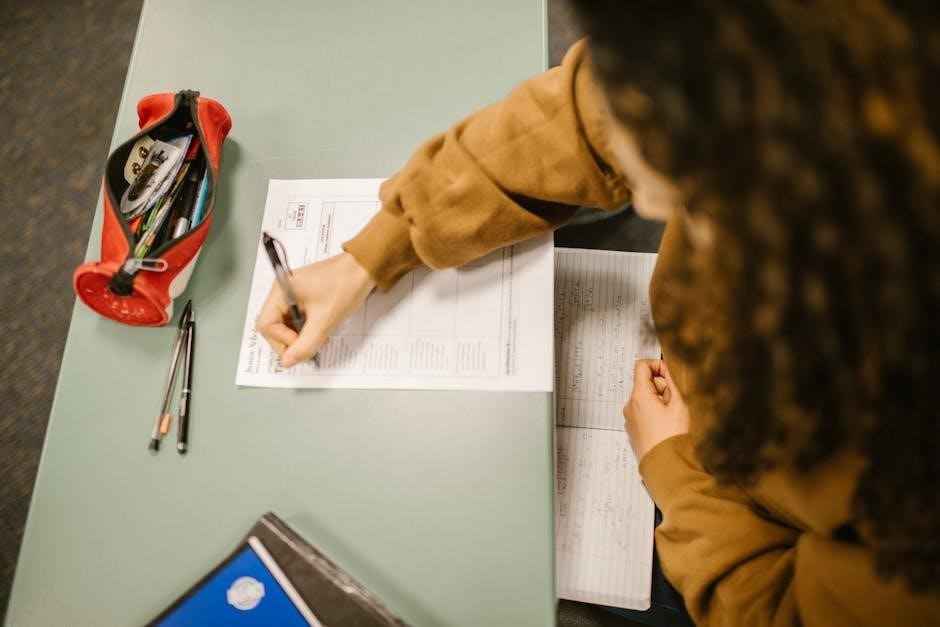
Test Day Logistics
Bring essential items like identification, pencils, and a ruler. Timing is crucial; arrive early and manage your time wisely during each section of the exam.
What to Bring to the OC Test
Preparation is key for a smooth test day experience. Students must bring their official notification advice with the test centre details and their unique identification number. A valid photo ID, such as a student ID or passport, is also essential for verification purposes at the test centre.
Stationery requirements are specific: students should bring a sharp HB pencil, a good quality eraser, and a ruler. Avoid mechanical pencils or coloured pencils. Pens are generally not permitted. It’s wise to bring a pencil sharpener, although some centres may provide them.
Comfort and essentials include a water bottle (clearly labelled) and a small, plain snack for a quick energy boost during breaks. Avoid sugary drinks or messy foods. Students should wear comfortable clothing appropriate for the weather. Do not bring any electronic devices, including smartwatches, phones, or calculators, as these are strictly prohibited.
Timing Strategies for the Exam
Effective time management is crucial for success on the OC Test. Begin by quickly skimming through the entire paper to understand the sections and question types. Allocate a specific time limit to each section, and stick to it as closely as possible, preventing overspending time on challenging questions.
Prioritize questions – start with those you find easiest and most comfortable, building confidence and securing marks. If you get stuck on a question, don’t dwell on it; move on and return to it later if time permits. Guessing is permitted, so attempt every question, even if unsure.
Regularly check the time and adjust your pace accordingly. Avoid rushing, but also prevent getting bogged down. Utilize any provided scrap paper for working out, but ensure all final answers are clearly marked on the answer sheet. Practice with timed mock tests to refine these strategies.
OC Test Day Checklist
Preparation is key for a smooth test day experience. Ensure your child gets a good night’s sleep and eats a nutritious breakfast to maintain focus and energy levels. Pack a pencil case with multiple pencils (HB recommended), a sharpener, and an eraser – no pens are allowed.
Bring identification, such as a student ID or a printed copy of the test confirmation email. A water bottle is permitted, but ensure it’s clearly labelled. Avoid bringing any electronic devices, including smartwatches or phones, as these are strictly prohibited during the exam.
Review the location and travel arrangements beforehand to avoid last-minute stress. Arrive at the test centre with ample time to spare, allowing for check-in procedures. A calm and prepared mindset will significantly contribute to optimal performance.
Understanding Your OC Test Results
Scores and percentiles indicate performance relative to other students; placement offers aren’t guaranteed, with reserve lists managing potential vacancies effectively.
Score Interpretation and Percentiles
Understanding the OC Test score requires considering both the raw score and the corresponding percentile rank. The raw score reflects the number of correct answers, while the percentile indicates a student’s performance relative to the entire cohort of test-takers. A higher percentile signifies better performance compared to peers.
Percentiles are crucial for interpreting results, as they provide context beyond the raw score. For instance, a score in the 90th percentile means the student performed better than 90% of other students who took the test. However, placement isn’t solely based on percentile; cut-off scores vary annually depending on available places and the overall performance of applicants.
The NSW Department of Education doesn’t publicly release specific cut-off scores beforehand. Therefore, focusing on maximizing performance and achieving a strong percentile rank is the most effective strategy. Parents should remember that the OC Test is just one factor in the selection process, and school reports also play a significant role.
Placement Offers and Reserve Lists
Placement offers for Opportunity Classes are typically released by the NSW Department of Education in March, following the OC Test results. These offers are initially extended to students who achieve the highest scores and meet the eligibility criteria, filling available places in designated schools.
However, due to the competitive nature of the OC program, a reserve list is also established. Students on the reserve list are ranked based on their test scores and may receive an offer if a place becomes available due to declines from initially offered students. The position on the reserve list is crucial, as offers are made sequentially.
Parents who receive an offer must formally accept it within a specified timeframe. Failure to do so may result in the offer being extended to the next student on the reserve list. Regularly checking the Department of Education’s website for updates and notifications is essential throughout the placement process.
Next Steps After Receiving Results
Upon receiving your OC Test results, carefully review the score report and percentile ranking. Understanding these metrics provides insight into your child’s performance relative to other test-takers, aiding in future academic planning. Regardless of the outcome, acknowledge the effort invested in preparation.
If an offer is received, promptly accept it through the designated channels within the specified timeframe. Familiarize yourself with the chosen Opportunity Class school’s policies and procedures, including orientation schedules and required documentation. Prepare for a smooth transition to the new learning environment.
If not selected, explore alternative enrichment opportunities and consider reviewing past papers to identify areas for improvement. Don’t discourage your child; focus on continued academic growth and development. Remember, the OC Test is just one measure of potential.